




· 7 min read
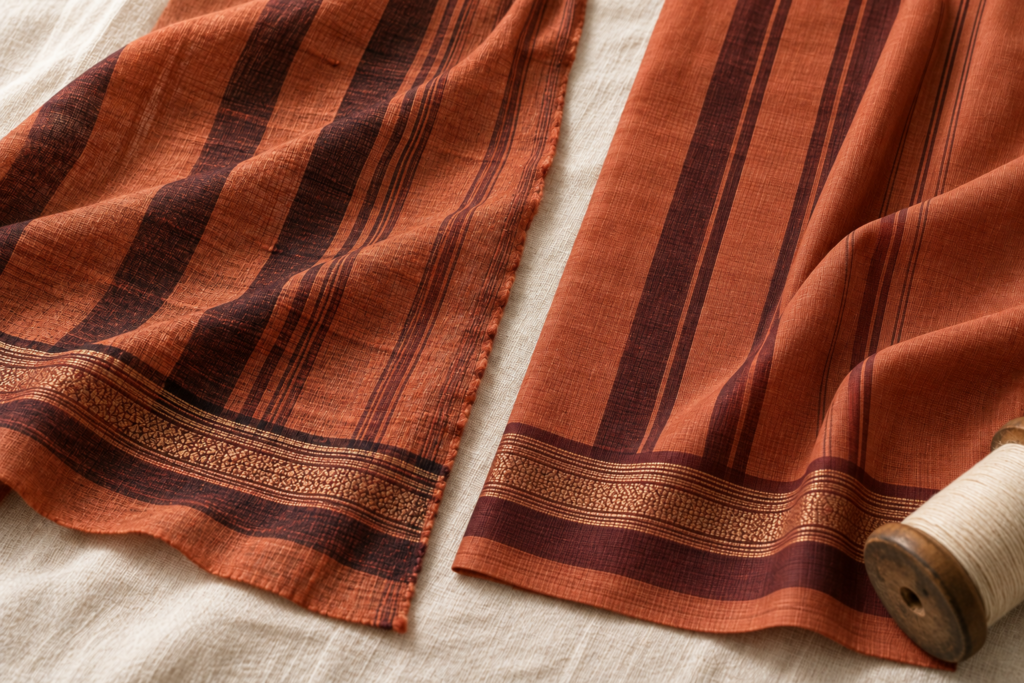
Quick answer: Check the selvedge (uneven on handloom, ruler-straight on powerloom), flip the fabric over (handloom shows small knots and thread joins on the reverse), and look for tiny irregularities in weight, weave and motif spacing — machine-made fabric is flawless from end to end; hand-woven fabric never quite is.
Walk into any fabric or saree shop and you’ll hear the word “handloom” thrown around a lot. It’s on tags, in Instagram captions, and in the pitch every salesperson gives you. The trouble is, not everything labelled handloom actually is. Here’s how to check for yourself.
Handloom and powerloom fabrics can look similar at first glance, but they come from entirely different worlds. Handloom is woven by hand on a traditional loom, often taking a weaver several days to finish a single piece. Powerloom is machine-made, churning out fabric at a fraction of the time and cost.
That difference in labour and time translates directly into price — and that’s exactly why the line gets blurred. A powerloom saree dressed up with a “handloom” tag can be sold for many times its actual worth. For the weavers who depend on handloom for their livelihood, and for buyers who want to pay for what they’re actually getting, knowing how to spot the real thing matters.
The selvedge is the tightly woven edge that runs along both sides of the fabric, meant to stop it from fraying. On handloom fabric, the selvedge is usually a little uneven — you may notice slight waviness, occasional loose threads, or minor variation in tightness as you run your hand along it. This is the natural result of a human hand controlling the tension, throw after throw.
On powerloom fabric, the selvedge is machine-perfect: straight, uniform, and identical from one end to the other. If the edge looks like it was cut with a ruler, it’s a strong sign the fabric came off a machine.
Flip the fabric over. This is one of the most reliable checks.
On a handloom piece, the reverse side often shows small knots, thread joins, or slight irregularities in the weave — signs of a weaver manually joining threads as they worked. The back may not look as “finished” as the front, and that’s actually a good sign.
On a powerloom piece, the reverse side tends to look almost identical to the front — smooth, even, and mechanically consistent, because the machine weaves at a uniform tension throughout.
This might sound counterintuitive, but imperfection is proof of authenticity. Handloom fabric will almost always have small, almost invisible irregularities — a slightly thicker thread here, a minor shift in the weave pattern there, tiny variations in the width of the fabric from one end to the other.
Powerloom fabric, by contrast, is engineered for consistency. Every inch looks like the last. If a fabric looks flawless and machine-precise throughout its length, it’s very likely powerloom.
Pick the fabric up and let it drape over your hand or hang freely.
Handloom fabric tends to have a slightly heavier, more textured feel, and it drapes with a soft, organic fall — it moves naturally with the body rather than holding a stiff shape. This comes from the slightly irregular tension of hand-weaving, which gives the yarn a bit more character.
Powerloom fabric is usually more uniform in weight, and its fall can feel a touch stiffer or flatter, since the tension is mechanically controlled from start to finish. It’s not a bad feel — just a different one, and with practice you’ll start to notice it immediately.
The single biggest tell of a genuine handloom piece is that a human being made it — and humans aren’t perfectly consistent, even the most skilled ones. Look for:
If you can’t find a single inconsistency anywhere in the fabric — not on the edge, not in the weave, not in the pattern — be suspicious. Real handloom cloth almost always gives itself away somewhere.
Weavers themselves often judge cloth by senses other than sight. Rubbing the fabric between your fingers near your ear produces a soft, slightly irregular rustle for handloom, versus a more uniform, “papery” sound for tightly machine-woven synthetic-blend powerloom fabric. Natural handloom cotton or silk, especially if recently off the loom, can also carry a faint raw, earthy smell from natural fibres and traditional dyeing — something mass-produced powerloom fabric, often treated with chemical finishes, typically lacks. This one’s folk knowledge passed down among weavers rather than a lab test, so use it alongside the checks above, not instead of them.
A genuine handloom saree or fabric length can take anywhere from a full day to several weeks to weave, depending on complexity. If you do the rough math — the cost of yarn, dye, and a fair wage for that many hours of skilled labour — a truly hand-woven piece simply cannot be priced as low as a machine-made one. If the price feels too good for the amount of work claimed, that mismatch is itself a red flag worth trusting.
At RooiRang, every piece we call handloom actually is. We work directly with weaver communities, so we see the fabric come off the loom ourselves — selvedge, reverse side, irregularities and all. Our Jamdani sarees are a good place to see everything in this guide up close — hand-thrown motifs, natural slubs, and all. We don’t need to convince you it’s real; we just show you where it came from.
When you buy from our handloom saree collection, you’re not just buying a fabric. You’re buying the hours a weaver spent at the loom, and a small part of a craft that machines still can’t replicate.
How can I tell if a saree is handloom or powerloom just by looking at it?
Check the selvedge and the reverse side first — a wavy, slightly uneven selvedge and a reverse side with visible knots and thread joins both point to handloom. A ruler-straight selvedge and a reverse side that looks identical to the front usually mean powerloom.
Does handloom fabric feel different from powerloom?
Yes. Handloom fabric is usually slightly heavier and more textured, with a soft, organic drape. Powerloom fabric tends to be more uniform in weight and can feel a touch stiffer, since it’s woven under constant mechanical tension.
Is handloom always more expensive than powerloom?
Almost always, and for a simple reason — it takes a weaver anywhere from a day to several weeks to hand-weave a single piece, versus minutes on a machine. If a “handloom” saree is priced like a mass-produced one, that mismatch is worth questioning.