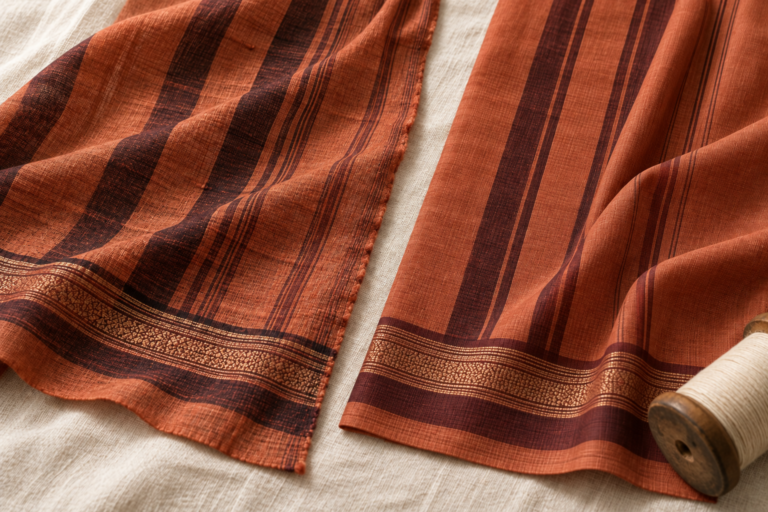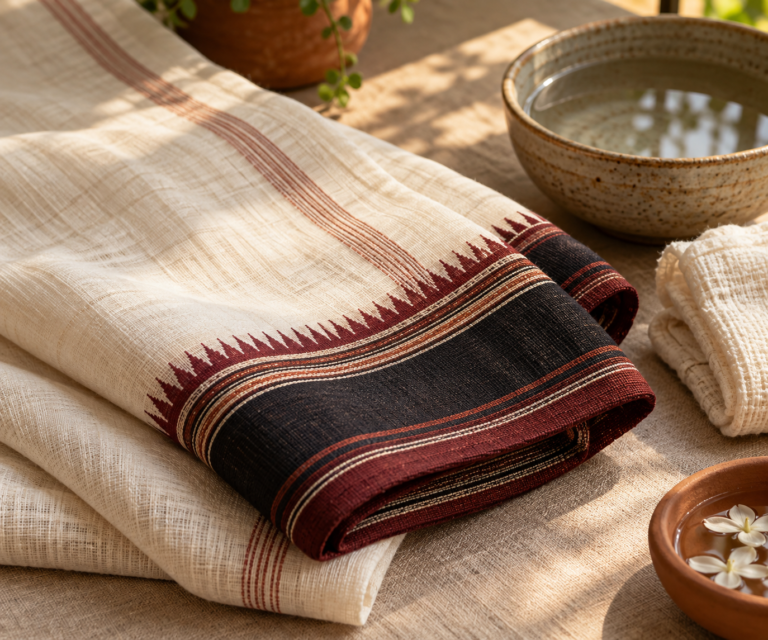
How to Remove Sweat Marks From Cotton Sarees and Kurtas (Without Damaging the Fabric)
To remove sweat marks from cotton: blot the area with a clean cloth, rinse in cold water, work in a…
Read more 4 min read


· 7 min read
Share
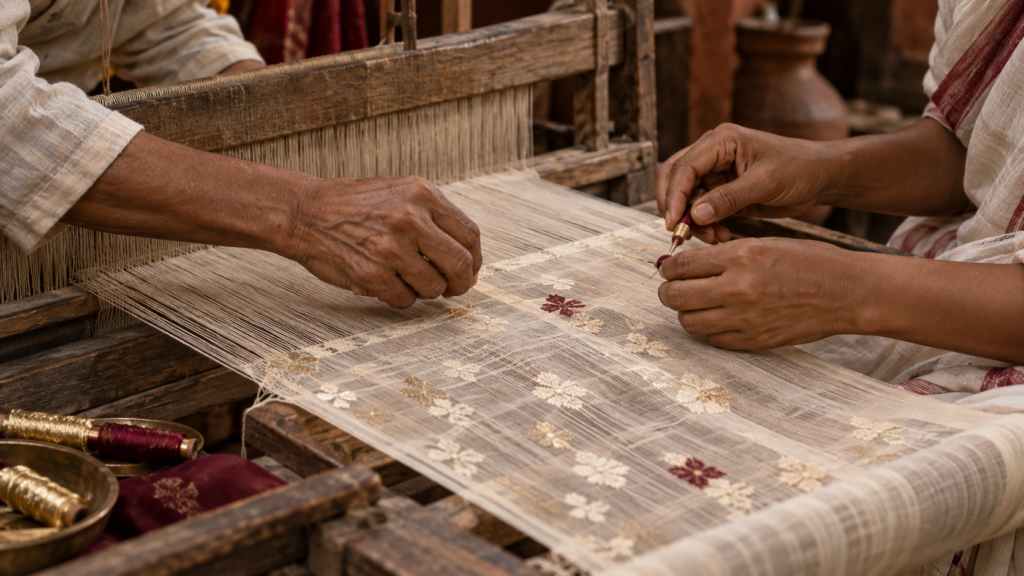
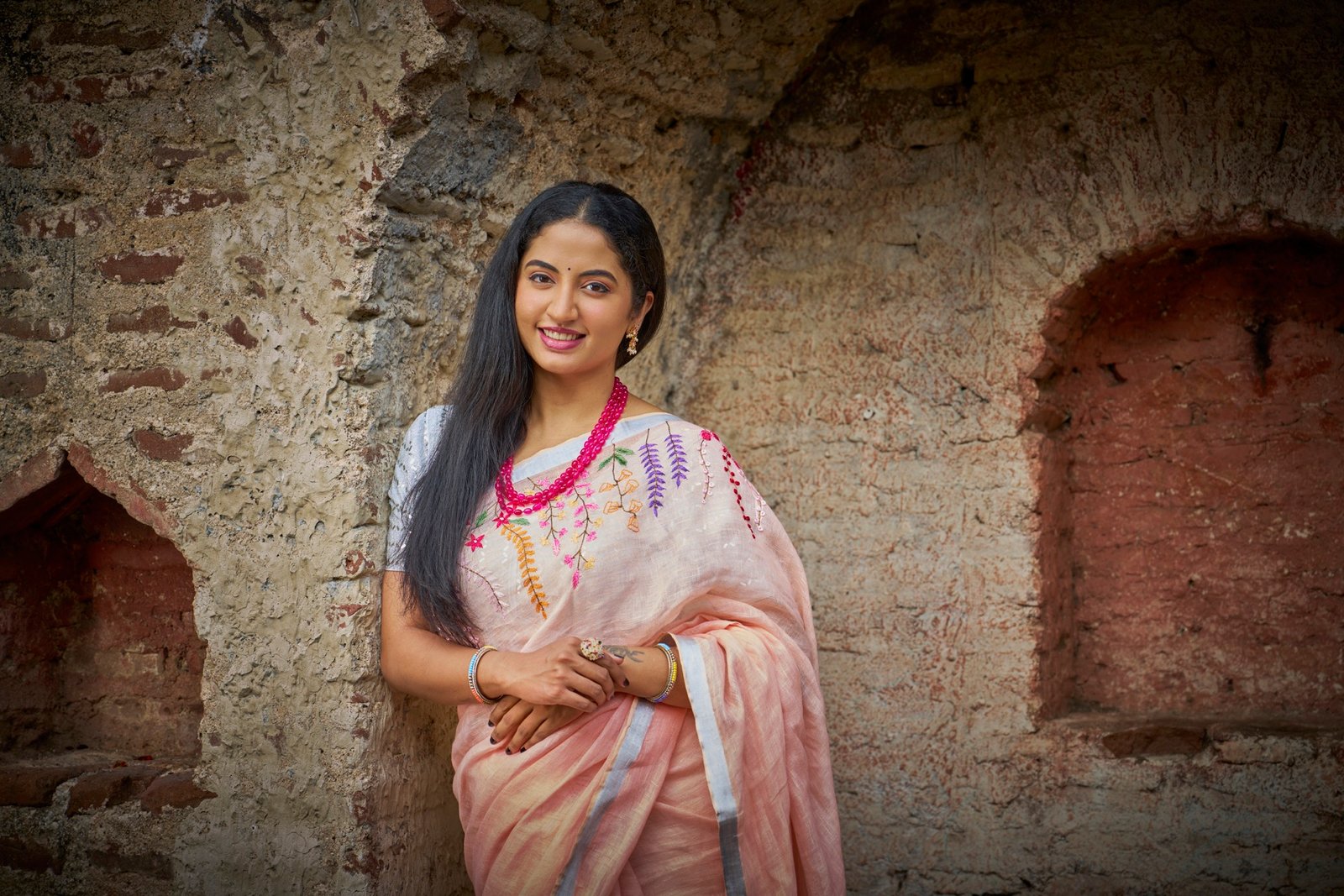
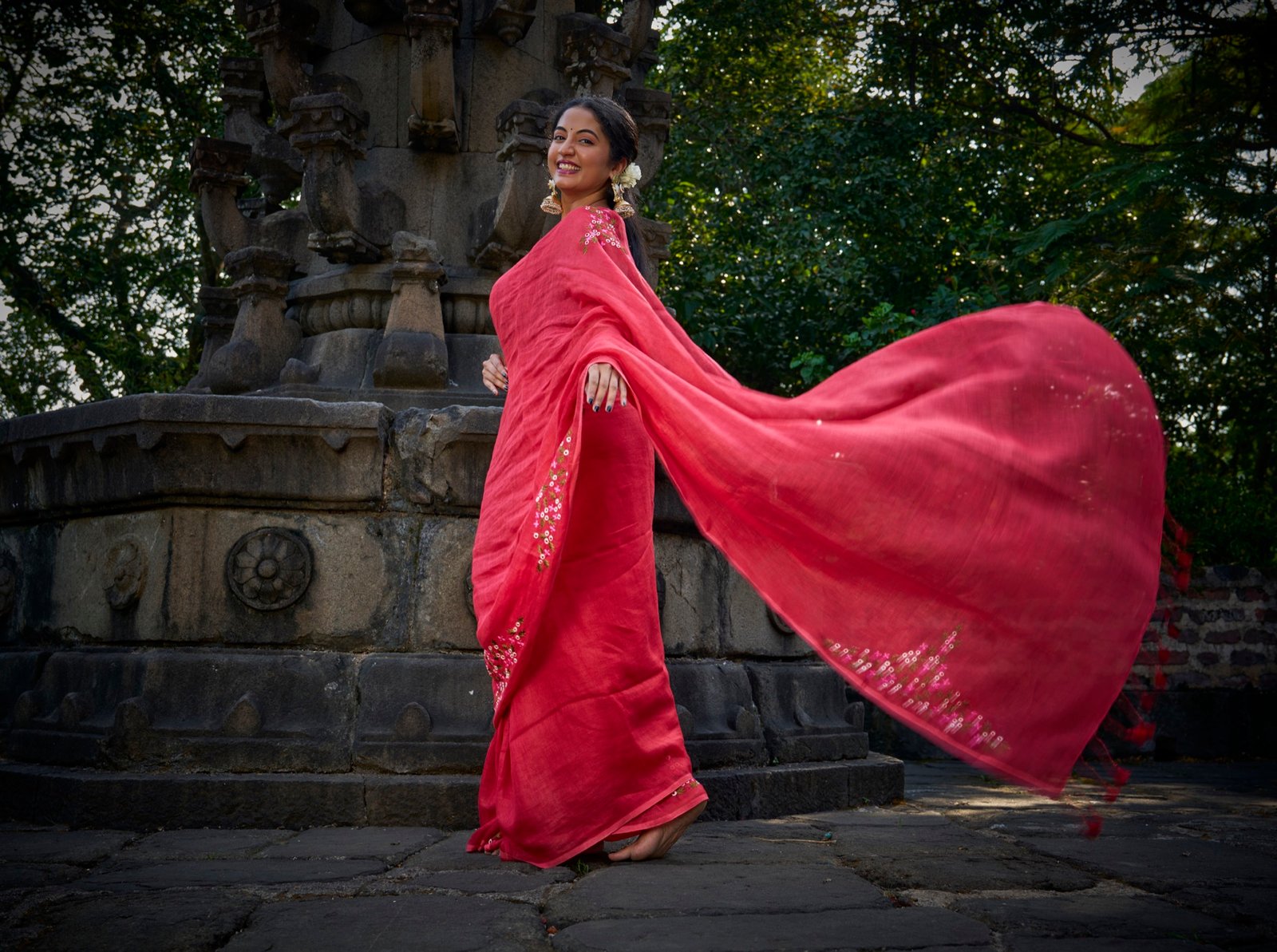
Two thousand years old, nearly lost to empire, UNESCO-recognised in 2013 — the story of Jamdani, Bengal’s handwoven “woven air,” thread by thread.
Quick answer: Jamdani is a 2,000-year-old handloom weaving tradition from the Bengal delta, in which two weavers work together to build a pattern directly into sheer cotton cloth, thread by thread, entirely from memory — no printed design, no repeat. A single sari can take weeks, sometimes months, which is why it’s recognised as a UNESCO Intangible Cultural Heritage (2013) and remains one of the most labour-intensive handlooms still woven today.
The river runs slow and warm through the Bengal delta, and it is here, along its banks, that this story begins — not with a name or a date, but with cotton so fine it seemed to come from nowhere at all.
For more than two thousand years, travelers who passed through this delta went home telling strange stories. Arab traders, Roman merchants, Chinese envoys — they had all seen cloth before, but nothing like this. A whole sari, they said, could be pulled through a finger ring. Fabric that seemed to vanish when held to the light. They started calling it woven air, because that was the only way to describe something that looked less like cloth and more like mist that had learned to hold a shape.
It took a long time for that mist to get a name. The word finally arrived with the Mughals, sometime in the early seventeenth century, when Emperor Jahangir was said to have worn a sash patterned with flowers so delicate they looked painted rather than woven. The court called it Jamdani — jam for flower, dani for vase, borrowed from Persian, because nothing in the local tongue quite captured it. Under Mughal patronage, the weaving towns around Dhaka became famous across three continents. Legend even softened into myth: that only mermaids, singing in the river fog, could weave a thread so fine. In truth, it was young weavers with impossibly steady hands, working near water because the humidity alone kept the thread from snapping.
Then came a century that nearly ended the story. British mills flooded Indian markets with cheap, machine-made cloth, and Bengal’s muslin trade — once worth fortunes to emperors and merchants alike — collapsed. Weaving families scattered. Some looms fell silent for good. But not all of them. In small towns like Shantipur and Fulia in West Bengal, and around Dhaka in what would become Bangladesh, weaver families held on, passing the craft from hand to hand the only way it had ever been taught: by watching, and doing, and watching again. When Partition came in 1947, some of these families crossed the new border and rebuilt their looms on the other side, carrying the pattern in memory because there was nothing else to carry it in — it’s this migration that seeded the West Bengal Jamdani weaving clusters RooiRang’s Best of Bengal sarees are woven in today.
In 2013, the world finally caught up to what those families already knew. UNESCO declared Jamdani weaving a piece of humanity’s Intangible Cultural Heritage. Three years later, in 2016, Bangladesh secured legal protection for the name itself. The mist had a certificate now. It still didn’t need one.
To understand why this cloth takes so long to make, you have to sit where the weavers sit — in a pit dug into the floor, loom rising up around them, two people working in a rhythm that looks almost like breathing. One weaver manages the base cloth, the plain, sheer handwoven cotton ground that will carry everything else. The second weaver is the one doing the real magic: in their hands are dozens of tiny bobbins, each wound with colored thread, sometimes silk, sometimes real gold or silver zari. There is no printed pattern taped above the loom. There is no chart. The entire design — every flower, every repeat, every border — lives in that second weaver’s memory, and they build it one supplementary thread at a time, looping each bobbin around the warp at exactly the right point before setting it down and reaching for the next.
This is the part that makes Jamdani unlike almost anything else woven on earth: the pattern isn’t printed on afterward, or embroidered once the cloth is finished. It’s created at the same moment as the cloth itself. Pull a thread and you’re not looking at decoration sitting on top of fabric — you’re looking at two things born together, row by row, for weeks.
A single row can take minutes. A single sari can take a month. If the design is dense with motifs, or the thread is fine enough to be nearly invisible, or gold zari is involved, it can take three months, sometimes more. And at the end, there will never be another one exactly like it — because nothing was copied from a machine, only remembered and recreated by a pair of hands that will interpret it slightly differently every single time.
So when someone asks why a Jamdani sari costs what it costs, the honest answer isn’t really about cloth at all.
It’s two skilled people, sitting for weeks, not one machine running for an hour. It’s a technique so demanding that it usually only gets learned one way — inside a family, over years, starting as a child watching a parent’s hands. It’s yarn so fine that it breaks if you rush it, which means you simply cannot rush it. It’s gold thread that costs what gold costs. And it’s the plain fact that this craft has stubbornly refused, for two thousand years, to be made faster — which is exactly the quality that let it survive empires, colonization, and the rise of the power loom, when so much else didn’t.
You are not buying a printed pattern on cotton. You are buying weeks of two people’s lives, and a piece of memory that has been carried, thread by thread, all the way from a river delta in Bengal to your hands — and won’t ever be woven quite the same way again.
Every RooiRang Jamdani sari is still made exactly this way — two weavers, one memory, months of work, nothing rushed.
Jamdani comes from Persian — jam means flower, dani means vase or container. The name arrived with the Mughal court in the early seventeenth century to describe the floral motifs woven into the cloth.
Because the pattern is woven into the cloth by hand, thread by thread, at the same time as the base fabric — not printed or embroidered on afterward. A single sari typically takes several weeks, and up to three months or more for dense motifs or gold-zari work.
Yes. UNESCO declared Jamdani weaving an Intangible Cultural Heritage of Humanity in 2013, and Bangladesh secured Geographical Indication (GI) protection for the name in 2016.
The base cloth is almost always fine, sheer cotton, but the supplementary threads used for the pattern can be cotton, silk, or real gold and silver zari, depending on the design and the sari’s occasion.
Enjoyed this? Share it
To remove sweat marks from cotton: blot the area with a clean cloth, rinse in cold water, work in a…
Read more 4 min read
Not every "handloom" tag tells the truth. 7 simple checks — selvedge, reverse side, weight, sound — to spot a…
Read more 7 min read